

- Patient Stories
- Lin Yue


"That 'Nail' in the Liver's Caudate Lobe – Finally Frozen Away" – My Cryoablation Experience at Uni-Asia Cancer Hospital
My name is Lin Yue. I'm thirty-two years old, and I'm an art teacher. I teach children how to paint skies, flowers, and all things bright. I never imagined that my own life would be darkened by a shadow buried in the deepest part of my liver.
Two years ago, a routine check-up revealed a small nodule in my left lung. At the time, I felt perfectly fine and assumed it was just inflammation caused by the paint fumes in my studio. But the post-surgical pathology results hit me like a cold blade: lung cancer. I cried; I fell apart, but at least it was caught early, and I managed to pull through. I thought that once it was removed, I'd be fine. I picked up my paintbrush again and went back to teaching children about spring.
But fate wasn't done with me. During a follow-up at the end of last year, doctors found a solitary metastatic lesion in the deepest part of my liver—a region called the "caudate lobe."
The caudate lobe. I'd never even heard of it before. The doctor told me it's the most concealed and dangerous part of the liver, surrounded on all sides by major blood vessels. That metastasis was like a nail driven into the gap between the hepatic vein and the inferior vena cava. The surgeon said the risk of operating was too high – if a blood vessel were nicked, the consequences would be catastrophic.
I refused to give up. Over the next two years, I fought like a soldier, trying every possible treatment: radiation, chemotherapy, targeted drugs, and immunotherapy. But the cancer cells seemed to develop resistance, recurring again and again, even growing more aggressively. The side effects from the drugs ravaged my body—my hair fell out, my skin darkened, and my hands and feet felt like they were wrapped in thick calluses, painful at the slightest touch. Worst of all was the unrelenting pain in my liver area—a deep, dull ache that kept me awake all night. I'd curl up in bed, feeling like a piece of wood slowly rotting away.
I became afraid of being alone, and even more afraid of the light. I locked up my studio, unable to bear the sight of those bright pigments—they stung my eyes, reminding me that my life was fading, color by color. I stopped answering my mother's calls. I stopped replying to friends' messages. I began to feel like I was that misplaced ""nail"—abandoned by the world.
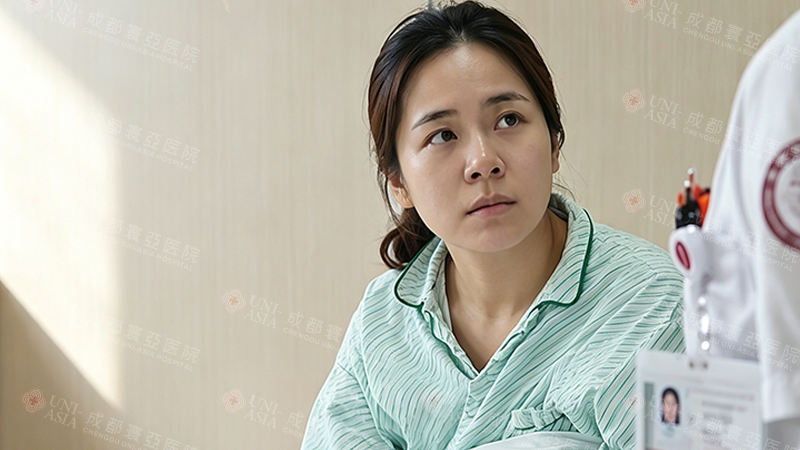
But my mother never gave up on me. She took my scans and visited every hospital she could, only to be met with silence and shaking heads. Then one day, she rushed into my room, red-eyed but with a glimmer of excitement: "Yueyue, there's a hospital in Chengdu—Uni-Asia Cancer Hospital—and their experts might have a way!"
My mother had seen videos about Uni-Asia Cancer Hospital online, especially the cases handled by Professor Liao Zheng-yin's team—cases involving high-difficulty tumors. She tremblingly handed me her phone. On the screen, a miraculous cryo-probe was freezing tumors that couldn't be surgically removed. At that moment, my long-stilled heart gave a faint, weak beat.
At Uni-Asia Cancer Hospital, Professors Liao Zheng-yin and Luo Xiao-ping studied my contrast-enhanced CT and 3D reconstruction images repeatedly. There was none of the head-shaking and sighing I had come to expect. Instead, Professor Liao pointed at that tiny "white dot" in the caudate lobe on the screen, carefully tracing the surrounding blood vessels with his pen, and said to me, "Xiao Lin, your lesion is indeed in a tricky spot—like a coin wedged in a crack in the wall. But we have a solution—multi-needle cryoablation."
Seeing my bewildered look, he patiently explained, "We don't perform open surgery. Under real-time CT guidance—like using Beidou navigation—we precisely insert several ultra-fine cryoprobes into the lesion. The tips of the probes can instantly drop to minus 150 degrees Celsius, forming an ice ball around the tumor. This ice ball directly 'freezes' the cancer cells to death. What's more, the extreme cold triggers a coagulation response, which actually provides natural protection to the surrounding major blood vessels, making rupture and bleeding highly unlikely."
"We place multiple needles at once, like a coordinated encirclement. The ice balls merge to perfectly envelop the entire lesion while carefully avoiding all the critical vessels. Does that make sense to you?"
I understood. It was just like when I teach children to paint – using a fine brush to slowly outline a shape without damaging the paper around it. With tears streaming down my face, I nodded vigorously. At that moment, I felt that the "nail" that had been pinned in the darkest corner of my life might actually have a chance to be pulled out.
On the day of the procedure, I walked into the CT intervention room on my own. Lying on the procedure table, I could see the busy experts through the glass in the adjacent control room. The anesthesiologist gently reassured me: "Don't be nervous – just sleep through it." I felt the slight swelling of the local anesthetic at the puncture site on my back and heard Professor Liao's steady commands: "First needle path is safe... in position... second needle in position... start freezing."
A cool sensation seeped through my right back, but there was no pain. Through the monitor, I could see that my vital signs remained stable throughout. In less than two hours, the procedure was over. When Professor Luo told me, "The ice ball imaging looks perfect—it completely covers the tumor, with no bleeding and no bile leakage," I buried my face in the pillow and cried silently. For the first time in a year, my tears were not from suffering.
That very evening, the deep liver pain that had tormented me for most of the year miraculously disappeared. The next morning, I sat up in bed and, for the first time in ages, finished an entire bowl of warm pumpkin porridge. Sunlight streamed through the window, and I couldn't help but reach out and catch a handful in my palm. It was warm.
During my hospital stay, I often thought about the studio I had locked away. When I returned home, the first thing I did was open that door. There was still an unfinished sunflower on the canvas—half of its petals bright, the other half shrouded in shadow. I picked up my brush, mixed the most vibrant chrome yellow, and carefully filled in that darkened half.
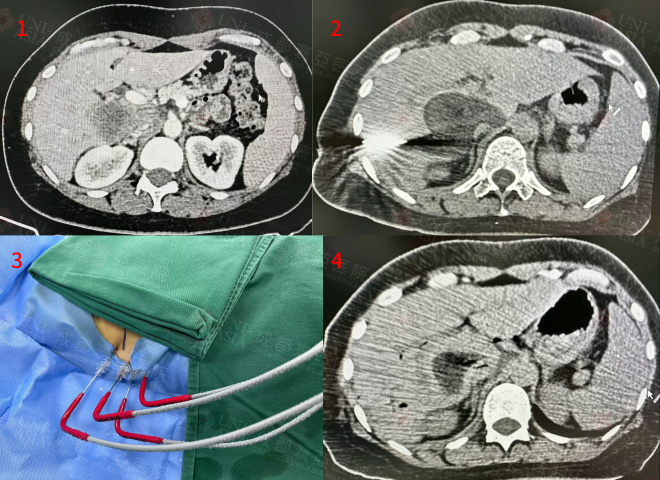
The accompanying CT images show the patient's pre-operative, intra-operative, and post-operative scans, clearly demonstrating complete tumor ablation.
Now, I'm once again the cheerful, talkative Lin Yue. Every weekend, when I teach my students, I tell them that the hardships in life are like a wrong brushstroke—as long as you find the right approach, you can always turn it into a flower.
Thank you, Uni-Asia Cancer Hospital. Thank you, Professor Liao and Professor Luo. With the most precise and coldest "scalpel" in your hands, you removed the deepest poison in my body while warming my entire life to its fullest. That long-dusted paintbrush can finally face the sunlight again and paint whatever I desire.